

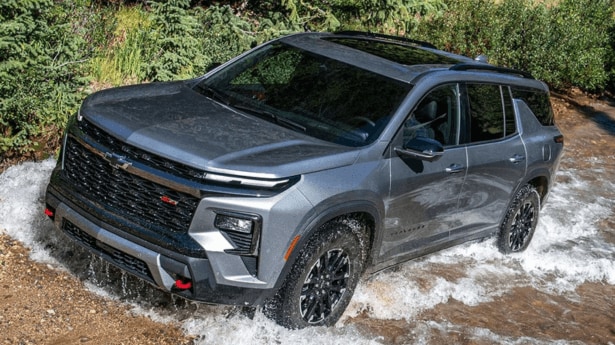
Chevrolet All-Wheel Drive (AWD) continuously monitors wheel slip electronically and automatically routes power between axles without driver intervention, whereas Four-Wheel Drive (4WD) utilizes a mechanical transfer case—offering selectable settings like 2WD, Auto 4WD, 4HI, and 4LO—allowing drivers to lock the front and rear driveshafts together for maximum traction. While AWD excels on changing, slippery paved roads, 4WD provides superior pulling torque in deep snow, heavy mud, and rugged off-road terrain.
Understanding how power reaches the pavement is the single most important factor when choosing your next vehicle. Chevrolet All-Wheel Drive systems rely on advanced electronic control modules and wheel-speed sensors. When the system detects a loss of grip on paved surfaces, it instantly transfers engine torque to the axle with the most traction. In modern crossovers like the 2027 Chevrolet Traverse, the available AWD setup operates seamlessly in the background. Drivers get enhanced stability during rain, light snow, and slush without having to flip a switch or press a button.
In contrast, Chevrolet Four-Wheel Drive systems are engineered for severe conditions and heavy-duty utility. Standard on full-size models like the 2027 Chevrolet Tahoe and truck platforms like the 2027 Chevrolet Silverado 1500, traditional 4WD employs a dedicated transfer case. This mechanical unit physically links the front and rear axles. When engaged in locked four-wheel modes, both driveshafts turn at the exact same speed, delivering uncompromising push and pull through unplowed snow drifts or slick job sites.
To experience how both systems perform in person, visit our Mount Vernon showroom or give our team a call directly at (740) 358-0441 to schedule a test drive on local roads.
What Is the Difference Between Auto 4WD and 4HI in Chevrolet Trucks and SUVs?
Auto 4WD automatically engages four-wheel drive only when sensors detect rear-wheel slippage and reverts to two-wheel drive when traction stabilizes, whereas 4HI mechanically locks the front and rear driveshafts into a continuous 50/50 power split regardless of road grip.
The primary distinction comes down to automatic adaptability versus full mechanical locking. Auto 4WD (often designated as AutoSense or AUTO on the dashboard selector dial) uses an electronically controlled multi-plate clutch inside the transfer case. In this setting, the truck or SUV runs primarily in rear-wheel drive to optimize fuel efficiency. The moment the system senses rear wheel spin—such as accelerating across an icy bridge or pulling onto a slushy main street—it engages the clutch in a fraction of a second to send torque to the front wheels. Once traction is re-established, it seamlessly returns to two-wheel drive. This makes Auto 4WD ideal for variable winter conditions where roads alternate rapidly between clear asphalt and slippery patches.
On the other hand, 4HI (Four-Wheel Drive High Range) bypasses automatic sensing entirely. Selecting 4HI locks the transfer case clutch, forcing equal power distribution to both the front and rear driveshafts at all times. This setting delivers maximum continuous traction when navigating unplowed country lanes, deep snowdrifts, or loose gravel roads.
Because 4HI locks the axles together, both driveshafts rotate at identical speeds. When making sharp turns on dry or high-traction asphalt, the front and rear wheels naturally want to travel along paths of different lengths. In 4HI, this difference creates mechanical resistance known as driveline binding or "crow-hopping," which can strain steering components and cause premature tire wear. For this reason, 4HI should only be used on loose or slippery surfaces, while Auto 4WD can be left on safely across mixed, dry, and wet pavement.
Shoppers evaluating capability across different model years can explore our pre-owned vehicle inventory to compare trucks and SUVs equipped with selectable transfer cases.
Which Drivetrain Is Better for Winter Roads in Mount Vernon: AWD or 4WD?
All-Wheel Drive is generally better for daily winter driving on paved, plowed, or slush-covered roads because it adapts automatically to changing traction without driveline binding, while Four-Wheel Drive is superior for navigating unplowed rural routes, severe snowstorms, and heavy winter towing.
Living in Mount Vernon means encountering diverse winter conditions, from freezing fog along the Kokosing River valley to sudden lake-effect slush. For commuters driving midsize crossovers, Chevrolet AWD provides ideal confidence. In models like the 2027 Chevrolet Traverse, the available AWD system is paired with a 2.5L turbocharged engine generating 328 hp and 326 lb-ft of torque through an 8-speed automatic transmission. This setup offers about 23 cubic feet of cargo space behind the third row and a towing capacity of 5,000 lbs, giving growing families plenty of utility for winter gear while automatically handling slippery pavement.
For drivers navigating hilly agricultural fringe routes around Mansfield where snowplows may take longer to arrive, a traditional 4WD system offers distinct advantages. Full-size vehicles like the 2027 Chevrolet Tahoe feature a 5.3L V8 engine delivering 355 hp and 383 lb-ft of torque through a 10-speed automatic transmission. With a tow rating up to 6,000 lbs and selectable 4WD modes, full-size SUVs provide the heavy-duty ground clearance and locked mechanical push needed to power through unplowed drifts and steep, unpaved driveways.
- Chevrolet AWD Advantages:
- Fully automatic operation requiring no driver action.
- Safe to operate continuously on dry, wet, or icy asphalt.
- Smooth power transfer that aids cornering stability in slush.
- Chevrolet 4WD Advantages:
- Selectable 4HI and 4LO modes for maximum pulling power in deep snow.
- Includes a 2WD mode to save fuel on clear summer highways.
- Superior low-speed crawl control for off-road or unpaved inclines.
When preparing for winter weather, taking time to value your trade-in online can help you upgrade to a more capable drivetrain before the snow arrives.
Does Twin-Clutch AWD Improve Handling and Stay Engaged All the Time?
Chevrolet's advanced twin-clutch AWD system significantly enhances handling on dry pavement by actively vectoring torque between the rear wheels, and while the system continuously monitors driving dynamics, it only engages the rear axle when extra traction or cornering stability is required.
Unlike conventional AWD systems that rely on a single center clutch and open rear differential, twin-clutch technology utilizes two independent hydraulic clutches mounted on the rear axle. This design allows the vehicle to send power not just from front to back, but specifically to the left or right rear wheel with the best traction. On the 2027 Chevrolet Traverse Z71, the twin-clutch AWD setup comes standard alongside all-terrain tires and off-road suspension tuning.
On dry pavement, twin-clutch AWD transforms dynamic handling. During sharp cornering, the system actively overdrives the outside rear wheel, pushing torque into the turn to reduce understeer and keep the vehicle tracking precisely through bends. When test-driving an AWD crossover on dry asphalt, shoppers often notice how torque vectoring tucks the vehicle cleanly into sharp turns without any tire scrub.
To maximize fuel efficiency during highway cruising, the system can decouple the rear driveshaft completely when extra grip is unnecessary. Once sensors detect steering inputs, heavy throttle, or road slip, the twin clutches engage in milliseconds. Drivers who want to plan their upgrade can apply for financing online to review competitive purchase options ahead of their test drive.
When Should You Use 4WD Low Range and How Fast Can You Safely Drive in 4HI?
4WD Low range is designed exclusively for low-speed maneuvering under 25 mph in severe conditions like deep mud, steep rock inclines, or boat ramp extraction, whereas 4HI can be safely operated at normal winter highway speeds up to 55 mph on snow-covered roads.
Understanding the gear reduction in 4LO is critical for protecting your drivetrain. Engaging low range changes the internal gear ratio inside the transfer case, multiplying engine torque to the wheels while severely limiting top vehicle speed. This massive mechanical torque advantage allows a truck or SUV to crawl out of deep ruts or descend steep, slippery hills using engine braking without overheating the brake rotors. You should never engage 4LO on dry pavement or drive at normal road speeds in this mode.
For typical winter highway driving on snow or ice, 4HI is the correct selection. Modern Chevrolet trucks like the 2027 Chevrolet Silverado 1500 feature shift-on-the-fly transfer cases that allow drivers to switch between 2WD, Auto 4WD, and 4HI at speeds up to 55 mph. When equipped with 4WD, the Silverado offers the popular Z71 off-road package as standard equipment, adding underbody skid plates, off-road suspension tuning, and hill descent control.
While 4HI delivers outstanding traction for accelerating and maintaining momentum through thick slush, it is essential to remember that four-wheel drive does not increase braking grip. Steering and stopping on ice still depend entirely on tire traction, speed management, and safe following distances.
Common Questions About Chevrolet AWD and 4WD Systems
Q: Can you leave Chevrolet Auto 4WD turned on all the time?
Yes, Auto 4WD is designed for continuous use during variable weather conditions. The system operates primarily in two-wheel drive until rear-wheel slip is detected, at which point it instantly routes torque to the front axle. Because it disengages automatically when road grip returns, it will not cause driveline binding on dry pavement, making it safe for daily all-weather commuting.
Q: How fast can you shift into 4HI in a Chevrolet truck?
Modern Chevrolet pickup trucks and full-size SUVs feature electronic shift-on-the-fly transfer cases that allow you to switch from 2WD to 4HI or Auto 4WD at speeds up to 55 mph. However, engaging 4LO requires stopping the vehicle completely, shifting the transmission into neutral, and selecting the low range on the transfer case dial.
Q: Does driving in AWD or 4WD decrease fuel economy?
Operating a vehicle in active AWD or engaged 4WD slightly increases fuel consumption because engine power turns extra drivetrain components, including driveshafts and differentials. Chevrolet Driver Selectable AWD and Auto 4WD systems mitigate this by disconnecting power to the secondary axle when extra traction is not needed, preserving fuel economy during clear highway cruising.
Q: What is the main advantage of the Z71 twin-clutch AWD system over traditional AWD?
Traditional AWD splits power between the front and rear axles and uses individual brake applications to limit spinning wheels. The twin-clutch AWD system standard on models like the 2027 Chevrolet Traverse Z71 actively distributes torque directly between the left and right rear wheels, sending up to 100 percent of rear torque to the single wheel with the most grip without relying solely on brake intervention.
Q: How does the 2027 Chevrolet Silverado 1500 4WD system assist with winter towing?
When equipped with four-wheel drive, the 2027 Chevrolet Silverado 1500 combines selectable transfer case modes with electronic stability control and available hands-free towing assistance. Selecting 4HI or Auto 4WD prevents trailer sway and rear-wheel slip when accelerating with heavy loads on icy boat ramps, slick highway entry ramps, or snow-covered job sites.